
From Climate Anxiety To Climate Action: Cities Take The Lead
Supported by Calouste Gulbenkian Foundation and written by Alison Tickell, Director, Julie’s Bicycle
Key Data
- 88% of cities’ culture departments collaborate with the environment or climate department
- 21% of cities have a designated climate role in the culture department
- 79% of cities are using culture to deepen citizen’s relationships to nature
INTRODUCTION
Global climate action is entering a new phase that recognises the essential role of people, values and imagination. Culture has moved from the margins of the climate debate to be a powerful driver of community action, policy change and regenerative solutions. Cities are hubs of creativity and innovation, and culture-based solutions to climate change are already in abundance.
From air pollution to climate migration, cities face urgent challenges and are developing practical solutions. Cities are where climate policy becomes reality, translated into infrastructure, services and citizen engagement. Cities have kept the Paris Climate Agreement alive, which aims to hold global temperature rise to 1.5 degrees, in spite of national political u-turns. When national governments retreat, cities often step forward. Cities are creating strong global and local networks, sharing expertise, policies and solutions.
But cities face significant barriers, lacking funding for climate mitigation, adaptation and pathways that ensure justice and fairness – the just-transition. Cities have also experienced public resistance or slow-moving institutions. This is where culture has power, by building social support for change, influencing lifestyle choices, and connecting citizens with what matters most to them. Culture is the foundation of the city and society, so culture should be the foundation for urban climate action.
Efforts to integrate culture into global discussions on climate solutions are gaining traction. At the time of publication (2025), the COP30 Climate summit in Brazil is approaching amid intense pressure on our planet and increasingly fragile multilateral commitments. In a context where climate summits have become places of intense scrutiny and public interest, the Brazilian Presidency has established the Global Ethical Stocktake (COP30 Presidency, 2025) and the Global Mutirão (shared responsibility) (COP30 Presidency, 2025) to highlight citizen participation and ethics at the heart of the process. COP President, Ambassador André Corrêa do Lago, has called on cultural actors to help in a ‘planetary renaissance’ and appointed the first Special Envoy for Culture and Creative Industries, Magut Etline.
The COP30 Presidency recognises that culture – arts, heritage and creative industries- are economic and social engines, protectors of heritage and indigenous knowledge, and powerful community-building forces. In a world facing conflict, rapid technological change, and growing social divides, cultural voices are being invited to help re-centre people, values and imaginative visions for a better future. To paraphrase the human rights and climate justice activist, Kumi Naidoo, it might not be enough, but without culture we will fail.
A powerful global creative climate movement is emerging through advocacy, practical tools, research and data, content and climate governance. As recently as 2021, very few national cultural policies referenced climate change (Julie’s Bicycle and British Council, 2021). Since then, there has been rapid progress: the COP Group of Friends of Culture-based Climate Action includes 50 national representatives (Ministério da Cultura do Brasil, 2025); and UNESCO, G20, and national governments are referencing culture in strategies for climate resilience, circular design, and mitigation. The ideation of culture and creative industries is also beginning to take shape within national climate action plans (Nationally Determined Contributions) submitted under the terms of the 2015 Paris Agreement.
This progress is the result of a long advocacy campaign, led by the cultural sector which has demonstrated that tested, real-world solutions already exist, with minimal risk and major opportunities for bold policymakers. While the recognition of culture-based solutions is increasing, policy development is still emerging and culture’s rich potential might take some years to translate into comprehensive climate policy support. In the meantime, cities need to keep ahead, as they have already done in climate policy and take on, through culture, new ideas and mediation between citizens, national governments and international agreements.
World Cities Culture Forum was an early champion of culture-based climate solutions. In 2018 World Cities Culture Forum partnered with Julie’s Bicycle and C40 Cities (World Cities Culture Forum, 2018) to showcase innovative culture-based solutions driving change, including:
- Melbourne’s six-year project Refuge that uses art, community and collaboration to explore how to prepare for and respond to climate disasters
- London, Amsterdam and Sydney’s tools and capacity-building including funding and grants for energy efficiency and sustainable venue and event guides;
- Cape Town’s commitment to innovation and sustainable city design, recognising economic resilience was dependent on creative innovation and cultural adaptation.
Seven years on and this report shows how much further these cities have come. From Tokyo to Dublin, 82% of cities surveyed have increased cultural engagement with climate and the environment since 2020 and in 88% of cities, the culture teams now collaborate with environment teams. However, limited policy alignment means many opportunities are still being missed. Culture has a unique ability to reframe climate narratives, by helping communities process loss, build connection and create positive alternatives. Despite strong commitment from culture departments, much of this work remains siloed and under-resourced.
Now is the moment to lead with ambition, bridging gaps, supporting and enabling green creative economies, and inspiring regenerative futures in cities around the world.
KEY TRENDS & INSIGHTS
1. Advancing Decarbonisation in Culture
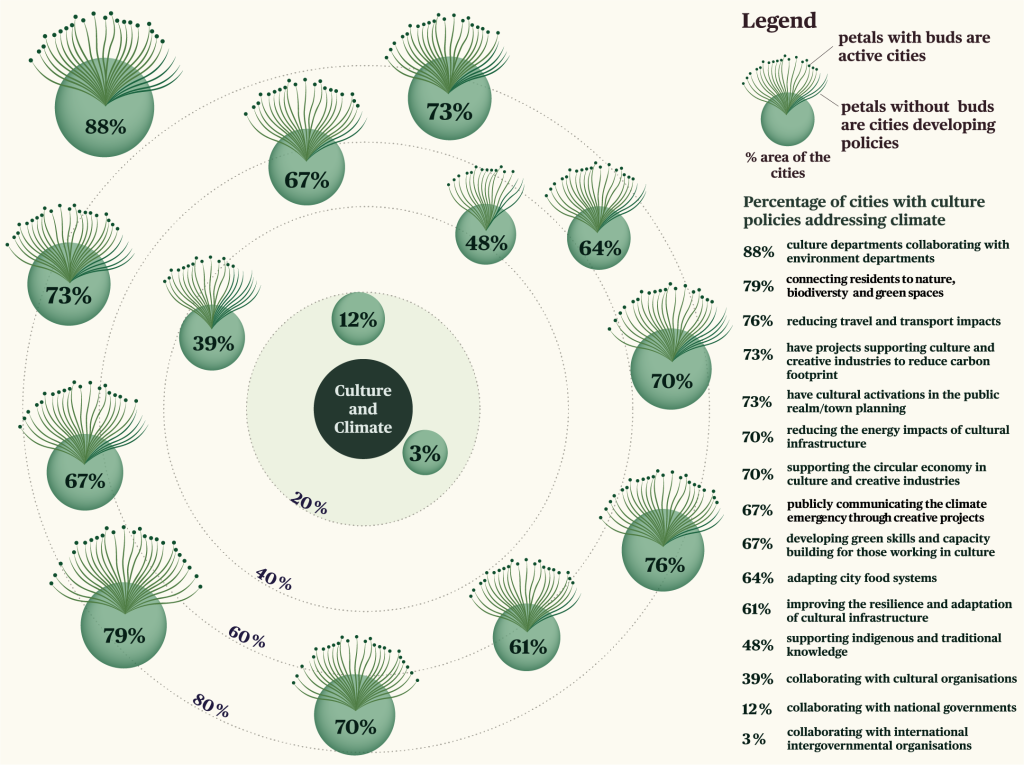
Cities are making meaningful progress in reducing emissions across cultural buildings, events, and creative industries. From Warsaw to Guangzhou, 70% of cities are addressing energy efficiency in cultural infrastructure through initiatives such as retrofitting venues and switching to renewables, while 76% of cities including Amsterdam and Hamburg are exploring low emission travel options associated with cultural activities. In addition, 73% of cities support creative industries in reducing their carbon footprints, as seen in Cologne’s Action Network for Sustainability in Culture and Media. Building culture programmes into wider city climate plans can enhance their impact and reach.
2. Growing Creative Circularity
70% of cities, including Paris, London, and New York, are embracing circular economy initiatives within culture, from shared materials libraries and repair workshops. These initiatives help reshape how resources are consumed in the creative sector and promote sustainability. To scale their impact and unlock environmental and economic benefits, culture teams need to embed circular practices into procurement, funding, and infrastructure development through dedicated policies and investments.
3. Strengthening Climate Engagement and Storytelling
Culture plays an important role in connecting communities to climate and nature challenges on both an emotional and a practical level. 79% of cities are using culture to deepen people’s relationships to nature, and 67% are drawing on creative work to communicate the climate emergency. Bengaluru’s Wake the Lake campaign revives the city’s dying lakes through community-led events, transforming them into shared public spaces and restoring local ecosystems. In addition, 64% of cities engage residents in climate policy through cultural initiatives, and 48% report incorporating Indigenous knowledge into climate planning – showing how culture can drive inclusive and locally grounded climate action. Culture’s unique ability to inspire hope, process emotions, and sustain citizen engagement is key to positive climate futures.
4. Enhancing Resilience and Adaptation
More cities are exploring how culture and arts can contribute to urban resilience and climate adaptation. From 73% redesigning public spaces through initiatives such as pedestrian zones and green infrastructure as seen in Barcelona, to 61% of cities improving cultural infrastructure to better withstand climate impacts by adding sustainable drainage and cooling and shading strategies. Artists also contribute to resilience and adaptation through leading community initiatives and helping prepare for climate disasters, as seen in Melbourne’s Refuge project. Stronger collaboration across city departments can help integrate culture into resilience planning, boosting social cohesion and community well-being during crises, and supporting recovery.
5. Unlocking Innovation in Policy and Funding
Cities are finding new ways to fund and support culture-driven climate action. In Helsinki and Oslo, this includes creating climate roles within cultural teams, while Austin’s Climate Equity Plan connects social and environmental justice as part of its 2040 net-zero target. Encouragingly, 21% of cities now have a dedicated climate role within their culture departments, showing increasing investment and policy prioritisation. This is an area with potential for growth across cities, which will accelerate progress. The expanding green creative economy, supported by public funding, subsidies and cross-sector partnerships, offers real potential for fair and sustainable economic transitions. Although 88% of cities report that their culture and climate departments work together, we can expect increased policy alignment in the future. Making climate a priority in cultural planning can unlock support, increase impact and highlight culture’s role in building a sustainable future.

Policy Recommendations
1. Build Strong Cross-Sector Collaboration
Achieving climate and nature goals through culture requires intentional, sustained investment in cross-departmental relationships, especially between culture, climate, and environment teams. Many environmental colleagues may not yet fully recognise the role culture plays in citizen engagement, storytelling, innovation, and equitable climate action. Cities should use local and global networks to share expertise, integrate culture into climate strategies, and ensure climate considerations are embedded within cultural policies. This governance alignment will help overcome silos, maximize impact, and elevate the role of cities as key partners in shaping national and international climate policies. Sharing learnings and expertise within networks such as the World Cities Culture Forum will accelerate progress and enable cities worldwide to benefit from tried and tested approaches.
2. Resource and Evidence Culture’s Role in Climate Action
Cities must dedicate funding, establish skilled leadership roles, and improve data collection and evaluation of cultural climate initiatives to unlock the potential of culture in addressing climate and nature challenges. Building an evidence base will strengthen advocacy, inform policy, and attract investment. Dedicated staff within city governments can embed culture-climate strategies into planning cycles, ensuring long-term commitment and accountability.
3. Support, Scale, and Elevate Existing Projects and Knowledge
Cities should connect to and map grassroots cultural climate initiatives – such as creative reuse projects, local food initiatives, and Indigenous community knowledge – and back them by providing funding, capacity building, and developing policy support. These efforts increase citizen engagement by involving communities directly in climate and nature solutions. National and international governments must recognise this creativity and embed culture-driven solutions into broader climate and sustainability decision-making. Elevating local innovations can make policies more inclusive, effective, and reflective of diverse community needs, creating replicable models for equitable climate action.
Data Visualisation Of Climate Policy Data