The Seoul Declaration: World Cities Culture Forum’s pledge for culture and inclusion in cities
A bold vision for culture in cities agreed at the World Cities Culture Summit 2017
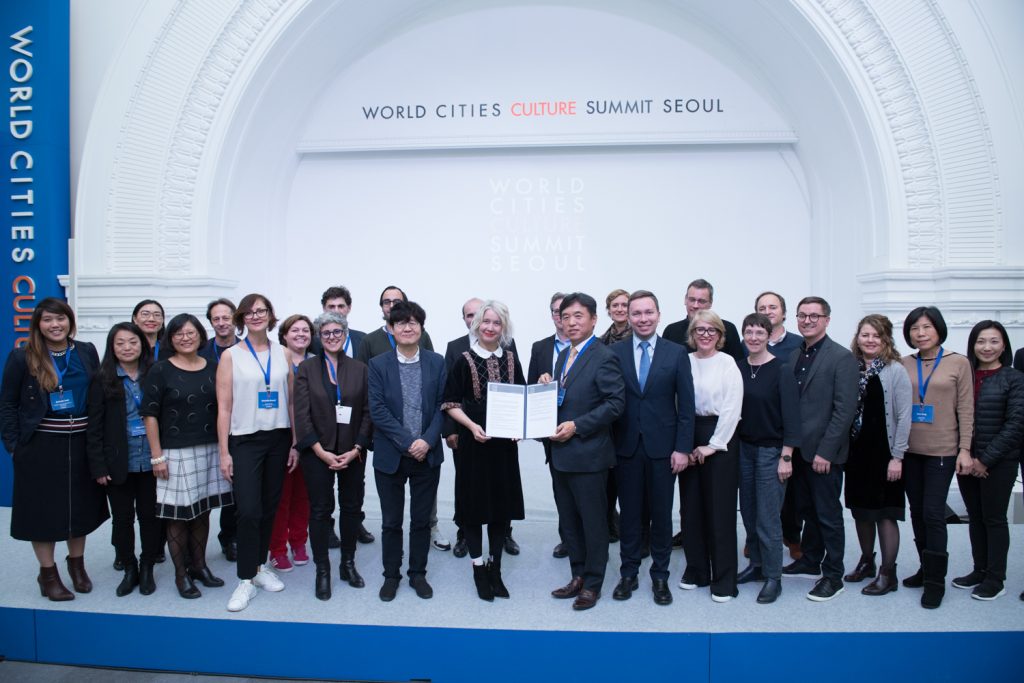
At the World Cities Culture Summit 2017 in Seoul, our cities gathered together to agree a new cultural agenda for cities.
The ‘Seoul Declaration’ was signed by all 27 cities present at our 2017 Summit, making a clear commitment to culture, openness and inclusivity in cities.
Since 2017, all new cities who join the World Cities Culture Forum agree to the principles outlined in the Seoul Declaration.
It is the responsibility of World Cities to offer a global, outward-facing vision of the world. In many countries, political forces threaten to turn nation-states inward, to seek protection from globalisation. By contrast, World Cities are home to citizens of the world.
The agreement calls on our cities to confront the divisive issues of xenophobia and prejudice and take an active responsibility for engaging all citizens in culture.
The Seoul Declaration recognises that:
World Cities are not only engines of the world economy, home to the world’s most dynamic and diverse populations, and centres of domestic and international power. They are also cultural beacons, shining a light across the globe through their exemplary artists, institutions and active citizens.
Article 27 of the Universal Declaration of Human Rights states that ‘Everyone has the right freely to participate in the cultural life of the community’. Cities must be places in which all citizens have a real stake, whether through housing, health, transport, education and social services. No citizen can be left out of the future.
The climate crisis continues to present an existential threat for World Cities. Some face the onslaught of adverse weather events; others must bear the brunt of the social and economic turmoil it creates elsewhere.
At the World Cities Culture Summit 2017 in Seoul, our cities demonstrated that:
Culture makes an essential contribution: it boosts local and national economies, it fulfils the creative lives of citizens, it fosters self-expression, it engenders a sense of civic pride and connection between people and the World Cities they inhabit.
Culture remains the golden thread in the vibrant economies of World Cities. Yet, at the same time it is so much more.
A truly successful World City needs all its citizens engaged in culture and creativity, to reinvigorate civic institutions and unite communities.
The evidence shows that culture can deliver happier, healthier and more fulfilled citizens. It can be a means to shape our responses to global issues like climate change and urban development.
Gentrification and other forces behind urban development can inhibit the creative forces that make our cities what they are. Artists, musicians, and makers need the space and resource to craft something from nothing. Culture can be fragile and vulnerable, and sometimes demands protection by city leaders.
The World Cities Culture Forum is a vital mechanism for bringing together Deputy Mayors and city leaders with shared challenges and shared ambitions, providing leadership in this landscape. An international response to today’s global challenges is necessary in our connected world.
As signatories to The Seoul Declaration, our cities commit to the following:
- To ensure that culture is a golden thread in all aspects of city policy, whether that might be housing or transport, health, or education.
- To make culture available to and empowering for all citizens (like we have seen in Seoul). Recognising that world cities are the workplaces, inspirations, safe harbours, and homes of outward-looking, open-minded citizens.
- To generate and learn from evidence and research, in pursuit of an enlightened and progressive approach to policy development and implementation.
- To act as leaders in our field and to continue to collaborate in the face of shared challenges and shared opportunities, as identified by the World Cities Culture Forum through its events, publications and networks.
While also being dedicated to:
- Pressing ahead with Making Space for Culture: to protect and preserve the places that make our cities what they are.
- Seeking out cultural responses to climate change, recognising that artists help us to comprehend the challenges we face.
- Speaking as one voice on behalf of all global citizens. To represent those who value humanist values of openness, exploration, and free enquiry. Global citizens value free expression and understand that art does not respect national boundaries.
- Developing the work of the World Cities Culture Forum through its Leadership Exchange Programme