



A Region on the Rise: Culture and Creativity in Southeast Asian Cities
Exploring the cultural and creative landscapes of Bangkok, Hanoi, Jakarta, Kuala Lumpur and Metro Manila
Jakarta is transforming into a culture-driven global city, not merely through infrastructural advancements or technology adoption, but by embedding arts and culture as the ultimate soul of urban development. – Rano Karno, Vice Governor of Jakarta (2025-2030)
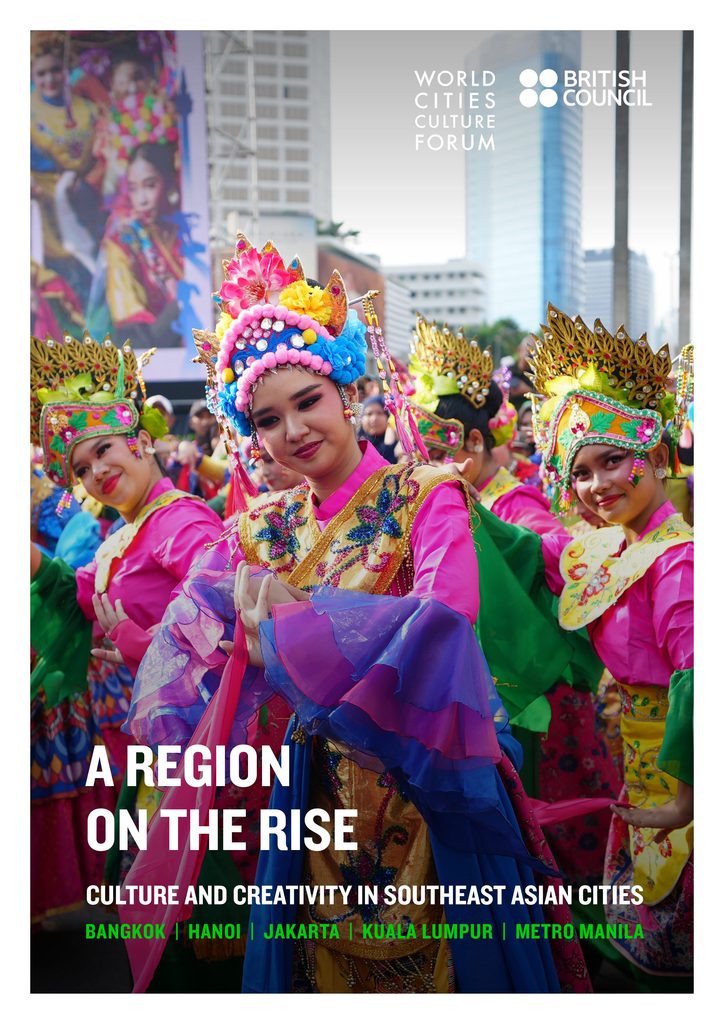
We’re delighted to launch A Region on the Rise: Culture and Creativity in Southeast Asian Cities, new research from World Cities Culture Forum in partnership with the British Council.
The research is launched today at the 15th World Cities Culture Summit in Tokyo, where more than 175 city leaders from across our global network come together to share ideas on culture in cities. This includes delegates from cities featured in the research from Makati City (Metro Manila), Kuala Lumpur and Jakarta.
It explores the cultural and creative economies of five of the region’s major cities: Bangkok, Hanoi, Jakarta, Kuala Lumpur and Metro Manila. Together these cities are home to more than 48 million people. All five belong to the UNESCO Creative Cities Network, across the fields of design, film and literature.
Southeast Asia as a region is the world’s fifth biggest economy, growing at nearly 5 per cent a year. More than half its population lives in cities, a share expected to reach 66 per cent by 2050. The creative economy already generates 4–8 per cent of national GDP in countries with available data. Through the ASEAN Creative Economy Sustainability Framework, launched in 2025, the region aims to become a global leader in the creative economy by 2045.
The research builds on our engagement in the region since Jakarta became our first Southeast Asian member city in 2024.
The Research
Research was conducted throughout 2026 by a team of local researchers based across the five cities. It combined in-depth interviews, stakeholder roundtables and consultations with political leaders, national cultural agencies, city governments, UNESCO Creative Cities representatives, researchers and practitioners across all five cities.
The report highlights six key findings across the five cities:
- Governance: cities with dedicated cultural governance, ring-fenced budgets and long-term planning authority are better able to connect culture with economic and spatial planning.
- Evidence: all five cities are rich in culture but lack the data needed for strategic planning and investment.
- Urban development: culture is a key asset in regeneration, protecting heritage and strengthening local economies and city identity.
- The creative workforce: creative work is dominated by small businesses, freelancers and informal workers, yet most policy is designed for formal enterprises.
- UNESCO designation: Creative City status is valued, but its potential to drive policy and institutional change is largely untapped.
- Collaboration: every city recognises the value of cross-sector collaboration, and intermediary organisations are emerging as vital bridges.
The report also sets out six policy recommendations for city governments, national agencies, regional bodies and international partners. Among them are city cultural observatories, a shared set of city-level cultural indicators, and a regional programme for cities to share models of governance, policy and finance. The eleven nations that make up the Association of Southeast Asian Nations (ASEAN) have a combined population of 684 million. This makes Southeast Asia the world’s third-biggest market and its fifth-biggest economy, growing at a rate of nearly 5% a year.
Read the report here.