Transformative partnerships: Barcelona brokers relationships between schools and culture and the culture sector
Project: designing the ‘Schools in Residence’ programme
The Purpose
Create a programme which facilitates partnerships between schools and cultural institutes, to promote the connection between culture and education. To support students’ cultural rights and increase participation of young people and their neighbourhood.
El Raval has one of Catalonia’s highest rates of early school leaving, more than twice the average across the region. However, it is also one of Barcelona’s most vibrant neighbourhoods, with an extraordinary concentration of facilities, including universities, the Museum of Contemporary Art, and the Centre for Contemporary Culture Barcelona (CCCB). Despite this, the rate of cultural consumption remains low among the local community.
The Challenge
El Raval, a neighbourhood in Barcelona, has a range of complex, diverse needs and inequalities. It is densely populated, with an unemployment rate of approximately 50%, and 53% of its community is migrants. Ensuring a long-term, in-depth relationship between the Centre for Contemporary Culture Barcelona (CCCB) and the secondary school (INS Miquel Tarradell) to create meaningful experiences and connections was challenging.

The Plan
Launched in September 2020, the School in Residence Program is an alliance between the CCCB and INS Miquel Tarradell Secondary School. They explore alternative forms of learning, connecting education with culture. In July 2020, after three months of intensive pandemic lockdown, the CCCB was forced to rethink its public programme. The mediation team saw the opportunity to deepen relationships with a nearby secondary school which was also facing great uncertainties about teaching for the term.
The School in Residence is part of the ‘Apadrina el teu Equipament’ (Sponsor your facilities) program, organised by the Tot Raval Foundation. It promotes collaboration between cultural facilities and schools. It also sits within the Neighbourhood Plan promoted by Barcelona City Council to resolve inequalities between the city’s neighbourhoods.
The aims of the School in Residence program are to:
Actively promote the connection between culture and education.
Support the cultural rights and participation of young people in El Raval, as well as that of their families and friends.
Open CCCB to the neighbourhood, which will influence its long-term programming.
The Impact
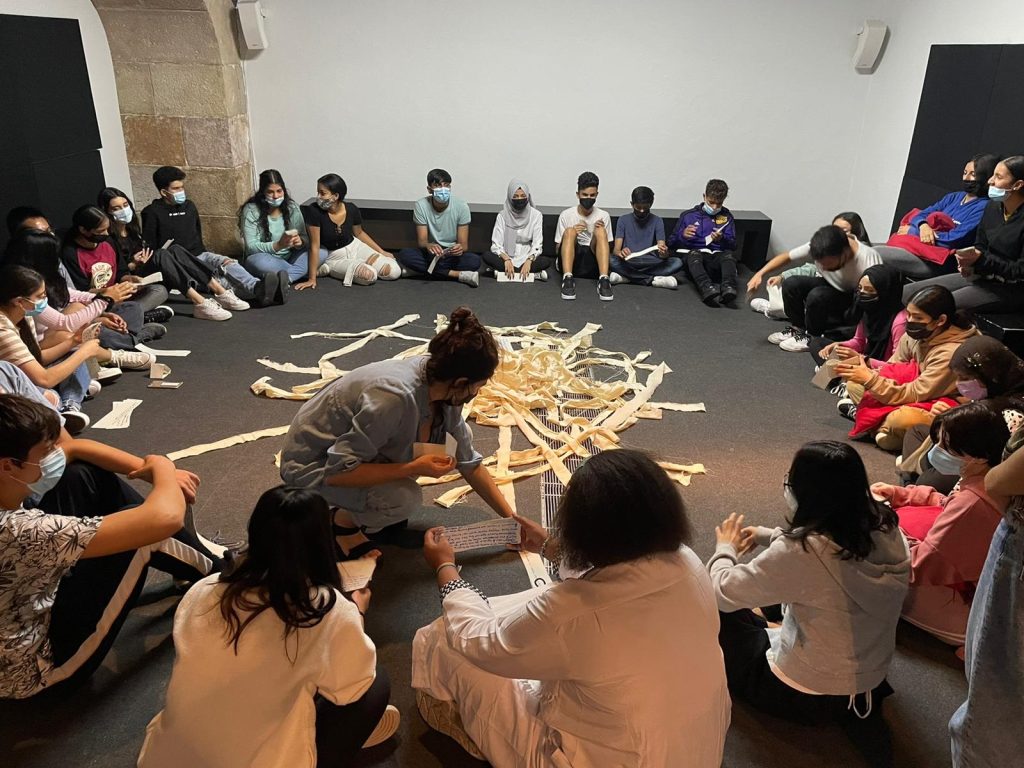
Since the program began, groups of students have spent around eight hours a week, per academic year, at the CCCB. The CCCB and school teachers work alongside a network of collaborators including scientists, thinkers, cultural producers and creatives. They create programs which raise important debates in contemporary culture.
The program has provided opportunities for learning and experimentation for everyone involved. It has become a core project for high school students and has positively impacted the whole school community. It is hoped that it will help to reduce segregation of students within school and lower early school leaving. Absenteeism has lowered among participating students.
Since the School in Residence program began a few years ago, it has become a core program for the CCCB. The CCCB has made closer relationships, not only with the participating school but with others across the community. It is perceived as more open and connected with its surrounding communities. Both the CCCB and the City of Barcelona hope to build on this success by promoting the connection between culture, education and communities across Barcelona.
Source: World Cities Culture Report 2022