How World Cities Are Making Streets Safer with Asphalt Art
Guest Blog by David Andersson, Arts Team at Bloomberg Philanthropies

A city’s streets and public spaces define its character and vibrancy, but too many urban streets are designed to prioritize cars over people. From Helsinki to Chicago, World Cities Culture Forum partner cities are bringing life back to their streets through a creative practice called asphalt art.
The Bloomberg Philanthropies Asphalt Art Initiative helps cities around the world make their streets safer and more welcoming for pedestrians through visual art interventions on streets, intersections, plazas, and other transportation infrastructure.
Painting art on city streets provides a visual reminder to drivers that these are people-centered spaces. Indeed, the 2022 Asphalt Art Safety Study found a 50% reduction in car crashes involving pedestrians and cyclists after asphalt art was introduced to challenging roads. And in addition to improving safety, these temporary, low-cost projects can lead to outsized social benefits that come with more people and fewer cars, such as better community cohesion or air quality.
A new grant opportunity is now open for cities in Canada, Mexico, and the United States. Teams of city agencies, community nonprofits, and artists can apply by January 31, 2025, for up to $100,000 for large-scale artistic interventions that aim to improve street safety, activate public spaces, and engage community residents.
In the lead-up to this new round of grants, we’ve highlighted some of the impressive Asphalt Art projects led by World Cities Culture Forum partner cities in the past three years.
“This Asphalt Art project can really help bring people together. Connection is really important in art, and that’s what it does here.”
Touria Meliani, Deputy Mayor, Amsterdam
Activating a neighborhood plaza with an artful game
(Helsinki, Finland, 2023)

Designers at Helsinki Urban Art led community workshops to plan a transformation of the large plaza in front of a neighborhood cultural center in Helsinki into an interactive world map, where people could act as game pieces traveling from continent to continent. After the mural was installed, the percentage of residents with a positive opinion of the plaza increased from 27% to 78%.
Bringing a neighborhood market to life
(Amsterdam, The Netherlands, 2021-22)
Amsterdam’s Asphalt Art project, “Surround Sound,” was designed to build connections between the city’s vibrant street art community and residents in the Nieuw-West district, a mixed-income area in the far west of the city with a diverse immigrant population. A unique partnership between the central city district government, Nieuw-West, the Street Art Museum Amsterdam and the Spanish lead artist Kenor, the project brought bright splashes of color to benches, planters, and portions of the sidewalk near a vibrant local marketplace, drawing customers on market days and enlivening the neighborhood for residents year-round.
“This Asphalt Art project can really help bring people together. Connection is really important in art, and that’s what it does here.”
– Amsterdam Deputy Mayor Touria Meliani
Increasing student safety with traffic-calming art
(Los Angeles County, USA, 2023)

In the diverse Washington neighborhood in Long Beach, in Los Angeles County, a busy intersection near two schools was in urgent need of improvement. The “Community Corners” project commissioned four artists to design murals in curb extensions at each corner of the intersection, visually and physically narrowing the roadway to improve overall safety for the most vulnerable road users.
Improving air quality with a colorful new public space
(Brussels, Belgium, 2023)
Yser Square was a formerly congested area in Brussels that was pedestrianized in 2023 to reduce traffic crashes and vehicular emissions. To activate the space, the City commissioned a new mural “Ys’Air, Sur leurs traces,” created by the art collective Patrimoine à roulettes together with Salvation Army’s Foyer du Selah as a way for diverse local communities to express themselves and reappropriate urban space through art. With up to 700 fewer vehicles traveling through the intersection during peak hours, there was a 22% reduction in the dangerous air pollutant NO2.
Empowering students to redesign a neighborhood gateway
(Chicago, USA, 2022)
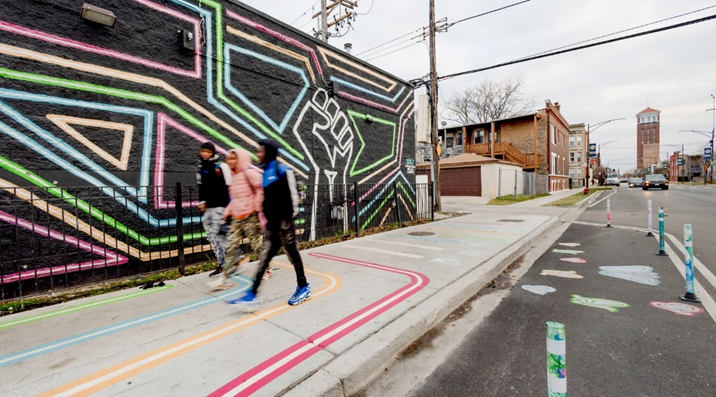
A busy intersection at the gateway to a neighborhood with a history of disinvestment in Chicago was identified by residents as having severe barriers to walkability. To address these concerns, the “WA|K-H: Gateway to North Lawndale” project was developed and installed by School of the Art Institute of Chicago along with a team of eight local high school students, working together with the community to bridge gaps and build connections through art.
Learn more about the Asphalt Art Initiative and how to apply at: https://asphaltart.bloomberg.org/