
How São Paulo’s carnival is boosting its creative economy
Insights from São Paulo’s Secretariat of Culture

Historically, São Paulo’s identity has centred on the image of a cosmopolitan city, characterized by industry, speed, work and progress. It is still Brazil’s most vibrant financial centre, and is among the world’s most populous cities, with numerous cultural institutions and a rich architectural tradition. But the Secretariat of Culture has been leading a cultural revolution. In 2015, The Guardian called the city an “Efferverscent chaos of mashed cultures”, while Culture Mag described São Paulo as “The city where everyone’s culture fits”. None of this is accidental.
With a population of 30 million people, we have always thought about how we can make culture accessible, democratic and participatory. In 1935, one of our first cultural initiatives was setting up libraries in public parks, and supporting musicians by creating the first official orchestra in the city – the Orquestra Sinfônica Municipal de São Paulo.
Embracing the subversive nature of carnival
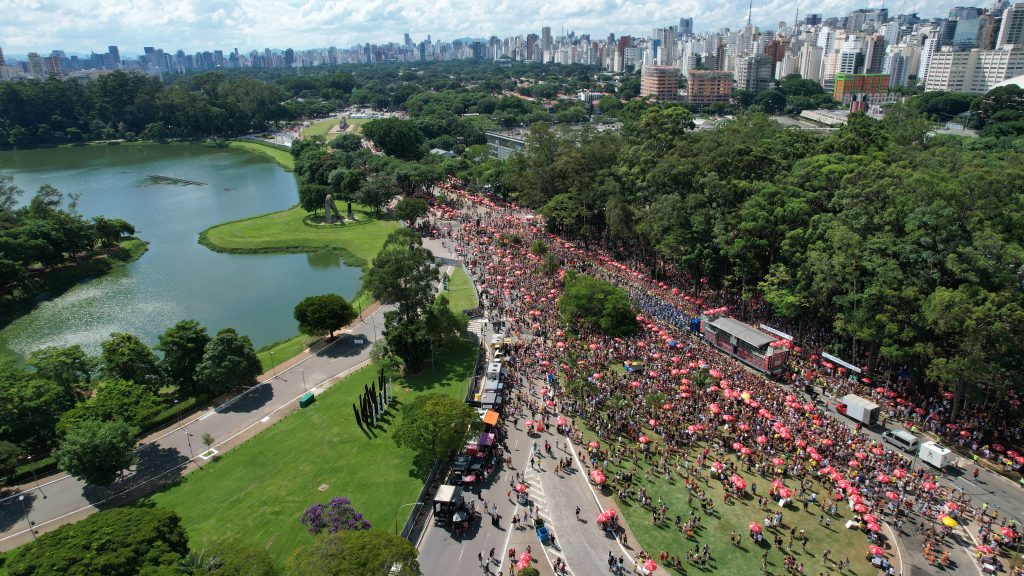
Today, one of the city’s most important cultural events on the calendar is of course carnival, one of the largest in the world. Like other carnivals in Brazil, it presents an opportunity to celebrate the city’s diverse communities, bringing together people from different social and economic backgrounds. Parades are egalitarian experiences. Hedonism, playfulness and self-expression through costume and dress are also used as protest. Feminist, communist, LGBTQIA+, black and all those who want to question political issues bring their campaigning to the street parties. Self-expression of all kinds is accepted and embraced.
Open and inclusive participation
In 2013, the Manifesto Carnavalista was created by independent carnival groups demanding greater visibility for traditional parades (also known as floats), that already have a strong identity and are authentically popular, as opposed to megablocks (known as “blocos”) or corporate blocks sponsored by brands. Currently, carnival blocks may be organized and managed by company sponsors, by civil society organizations, by artistic collectives, or by individuals.
Many young people participating in carnival blocks and collectives are entrepreneurs – even if they don’t have a formal job in the cultural production sector – and they act as trendsetters, signalling and promoting significant new trends in music, fashion and art. The inclusive nature of carnival embraces young people’s innovation and creativity, and recognises their contribution to the development of the local economy and the cultural life of urban centres. Carnival helps younger generations feel represented in their city’s public life.
“The notable growth of street carnival is part of a broader movement underway in the city, claiming public spaces and appropriating such spaces as meeting places, culture, sports and parties. In addition to Carnival, many other festive and sporting manifestations have been increasingly using the avenues, tunnels, parks and squares of the city of São Paulo, marking a cultural change in the ways of seeing and living the city and also of its own inhabitants. ” Raquel Rolnik, Brazilian architect and urban planner, born in São Paulo.
Boosting the creative economy
From 2017 onwards, public attendance and economic impact from São Paulo’s carnival has grown exponentially, with an estimated 15 million participants, 678 parade blocks and an economic return of R$ 2.65 billion in 2020. The growth of the grassroot, street blocks in communities across the city were responsible for 91% of the economic impact, while the Sambódromo parades which are corporately sponsored accounted for only 9%. Partying has a purpose in this city.
This insight blog was written by colleagues from São Paulo’s Secretariat of Culture


