
Digital Heritage: How Nanjing enriched its City of Literature heritage with digital technology
Project: Using big data, augmented reality and a citywide cultural network to enrich the city’s 1800-year literary heritage

Nanjing, with its 1,800-year literary heritage, transformed its cultural narrative through digital innovation. By leveraging big data, artificial intelligence, virtual reality, and augmented reality, the City of Literature’s heritage has been enriched. The network of over 1,000 QR codes on cultural landmarks has generated more than 40 curated literary routes, provided infrastructure for over 100 cultural and tourism enterprises, and enhanced smart tourism services across the city.
Building the “1+1+1” model
The core challenge was how to connect Nanjing’s ancient literary legacy with the expectations of contemporary digital audiences. Many cultural heritage sites are dispersed across the city, making accessibility uneven. The project needed to ensure that digital transformation preserved cultural depth while also creating replicable and academically valuable models that could serve both the public and cultural policymakers.
To meet these challenges, the project introduced the innovative “1+1+1” model, which consists of three interrelated layers:
- Data foundation: Firstly, more than 40 million characters of Nanjing’s literary texts were extracted, proofread, and digitised. Using AI-driven algorithms, this material was transformed into a dynamic literary knowledge graph that is both interactive and expandable.
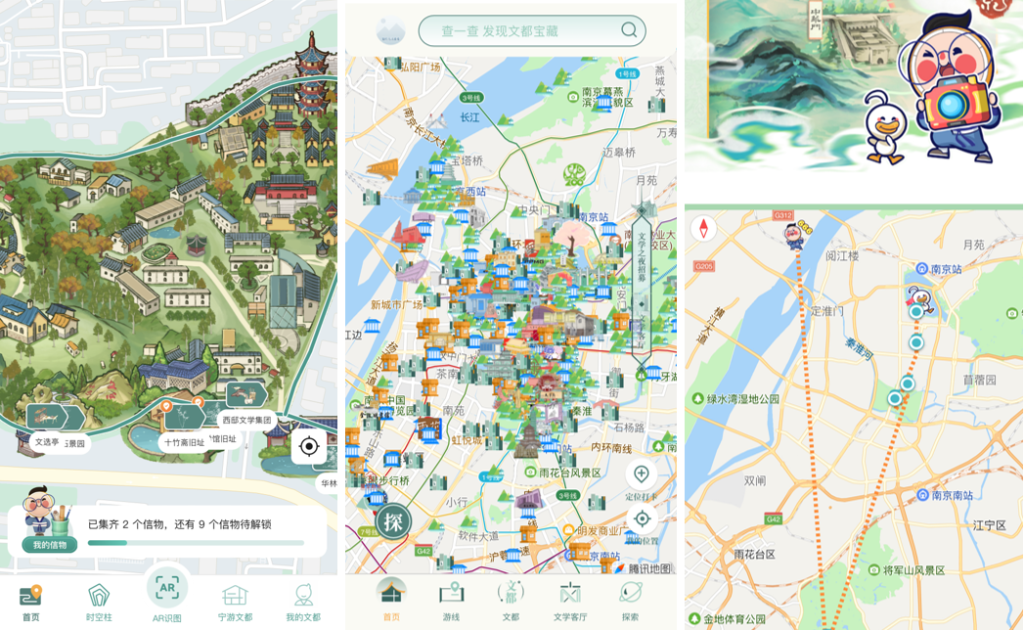
- Citywide cultural network: A network of over 1,000 QR codes placed at museums, heritage landmarks, and cultural spaces connects residents and tourists to Nanjing’s literary past. Through GIS technology, visitors can explore intelligently generated literary routes that integrate online and offline cultural engagement across the city.
- Digital cultural and tourism experience: At the historic ‘World Literature Hall’, cutting-edge technologies such as the Unreal Engine 5 (UE5), a real-time 3D creation tool, cloud rendering, VR, and AR deliver immersive storytelling experiences. This fusion of physical and virtual space allows visitors to engage with literature in unprecedented ways.
Impact on cultural tourism and policy
As China’s first ‘Literature+’ intelligent big data platform, the initiative has already attracted over one million participants. The network has generated more than 40 curated literary routes, provided infrastructure for over 100 cultural and tourism enterprises, and enhanced smart tourism services across the city. The standardised digital workflow and universal algorithm developed here provide a scalable model for other cities aiming to integrate heritage with digital tools.
The City of Literature project is not limited to Nanjing. Its methodologies can be adapted to cultural, culinary, design, and film-focused urban contexts worldwide. By combining government, academia, and industry collaboration, the initiative strengthens cultural tourism, drives digital transformation, and enhances international visibility. For policymakers and cultural planners, it represents a replicable strategy for embedding heritage into smart city ecosystems.