Cultural Infrastructure: How Paris integrated a media library and a refugee house
Project: James-Baldwin Media Library and Refugee House
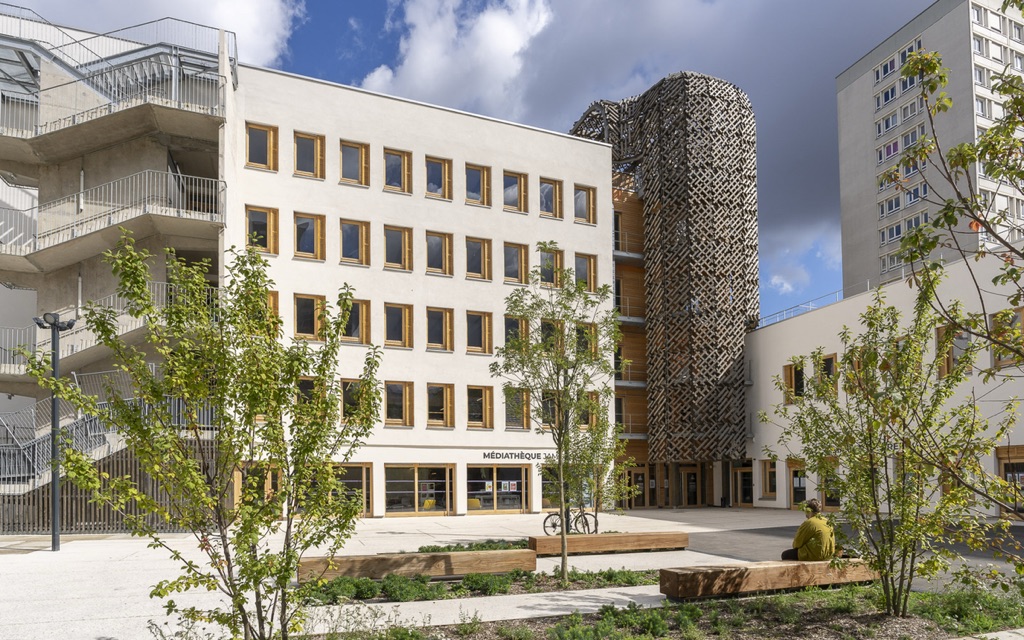
Launched in July 2024, the James-Baldwin Media Library and the Refugee House form a pioneering dual institution located in the former Jean-Quarré High School in Paris’s 19th arrondissement. Designed to serve both local residents and newcomers, this collaborative cultural and social hub fosters community integration, mutual understanding, and inclusive access to public services. The two facilities represent a bold response to contemporary urban challenges through innovative use of public space.
The James-Baldwin Media Library: inclusive access to culture
Spanning four public floors and covering 3,000 square metres, the James-Baldwin Media Library offers over 80,000 items for loan, including books, comics, musical scores, and digital media. Visitors can play board and video games onsite or borrow musical instruments. The library joins four other Parisian libraries in offering dedicated services for deaf visitors, including French sign language interpretation. As part of Europe’s largest public reading network, it reinforces the city’s commitment to equitable cultural access.
A new vision for the Refugee House
Previously located in the 14th arrondissement, the Refugee House now occupies a 1,000-square-metre facility on Place des Fêtes. This welcoming centre supports migrants and asylum seekers with French language courses, professional development opportunities, and community-building activities. Managed by Emmaüs Solidarité and Singa, and designed by the City of Paris, the facility works with nearly 50 partner organisations to foster integration and social cohesion. A café and regular cultural events also engage the wider community in conversations around migration and inclusion.
A shared project rooted in solidarity
Connected by a central building, the James-Baldwin Media Library and the Refugee House share common spaces including gardens and a 6,000-square-metre forecourt. This layout encourages daily interaction among visitors, residents, and newcomers.
Both institutions work together on initiatives and partnerships around collections inherited from the Place des Fêtes library (foreign language books and French as a Foreign Language – FLE) or acquired by the media library on themes of exile and migration. The goal is to make residents more aware of the reality of those who come through the doors of the Refugee House.
Beyond migration, the two institutions jointly address broader themes such as feminism, LGBTQIA+ visibility, and environmental sustainability — affirming their role as active civic actors in the public realm.
From emergency shelter to cultural catalyst
Architect Philippe Madec led the site’s eco-conscious renovation. By prioritising preservation over demolition and reusing materials onsite, the project aligned with the city’s climate goals. Public gardens – including a planted square, outdoor reading spaces, and green-rooftops – span 6,000 square metres, promoting biodiversity and environmental education alongside cultural programming.
The site itself carries a powerful symbolic weight. In 2015, the disused Jean-Quarré school served as an informal shelter for more than 1,300 migrants under precarious conditions – widely documented in literature (notably by Mathilde Weibel, Isabelle Coutant, and Juliette Kahane). Following a city-led evacuation and temporary reopening as an emergency accommodation centre, the space was transformed. Informed by an extensive public consultation involving 2,500 local residents, the City of Paris redeveloped the building as a permanent, inclusive civic asset.